Clint Eastwood, Morgan Freeman & Matt Damon’s ‘Invictus’:
Drawing Parallels Between Mandela and
the Custodian Chief Executive
and
’60 Minutes’: The Custodian Chief is Canada’s Leader-in-Waiting
© 2010 Brad Kempo B.A. LL.B.
Barrister & Solicitor
The coalition has drawn an historic and professional parallel between Mahatma Gandhi, Nelson Mandela and the Custodian Chief Executive. All three were lawyers compelled by the circumstances of their time and the nature of government in each country – India, South Africa and Canada – to engage in fundamental reform. There is one critical difference, however. Unlike the two other Commonwealth barristers, the Canadian lawyer didn’t voluntarily and volenti accept the challenge. He was forced to in order to escape an enslaved, torturous hell on Earth.
Hollywood joined the fight against imperialistic totalitarianism and the proliferation of stealth cognition technologies beginning with ‘Dogville’ and ‘The Manchurian Candidate’. As the diplomacy archive clearly shows, it regularly contributed to the effort to contain China, fix Canada and eradicate the 21st century’s Pandora’s Box. ‘Invictus’ is another initiative designed for these purposes.
There now appears to be no coincidence that it’s lawyers who time and time again address profound institutional corruption, criminality and human rights abuses to halt the carnage occasioned by them: Diplomatically Embraced Multi-Decade Oppressed Lawyers are 2-for-2 Fundamentally Reforming Government: Canadian Lawyer on the Verge of Making It 3-for-3. What separates his two predecessors was argued in Unlike Gandhi & Mandela, the Custodian Chief is Not a ‘Volenti Democracy Martyr’.
The December ’09 released feature film 'Invictius' sought to draw this comparison. It was directed by Clint Eastwood, who garnered Geo Award nominations for two geo-politicized movies*, and produced by Morgan Freeman, who played Mandela.

* Angelina Jolie, Clint Eastwood and Brian Grazer’s ‘Changeling’: High Profiling Canadian-Wide Police Corruption and Chinada Complicity and Using Psych Wards for Political and Geo-Political Purposes; and Three More Superstars Join the Exclusive ‘Capital Punishment Club’ and Clint Eastwood’s ‘Gran Torino’: An Extraordinarily Graphic Depiction of the Coalition’s Intention to Contain and Neutralize the Chinada Threat
Invictus is a 2009 biographical drama film based on events in South Africa before and during the 1995 Rugby World Cup, hosted in that country following the dismantling of apartheid. Directed by Clint Eastwood, the film stars Morgan Freeman as South African President Nelson Mandela and Matt Damon as François Pienaar, the captain of the Springboks, the South African rugby union team. The story is based on the John Carlin book Playing the Enemy: Nelson Mandela and the Game That Changed a Nation. Invictus was released in the United States on December 11, 2009.
The title may be translated from the Latin as undefeated or unconquered.
Source: wikipedia.com

The movie contains the lexicon throughout; beginning in true coalition style with the opening scene. Eastwood et al. wardrobe extras playing rugby in prison certainty. 
Immediately following is a Dogville punishment communiqué that also serves to describe what happened to Canada in the hands of its political and corporate leaders and Chinese. As Mandela’s motorcade passes by a coach and a high school age player are watching the procession of vehicles:
Player: Who is it sir?
Coach: It’s that terrorist Mandela. They let him out. Remember this day, boy. This is the day our country went to the dogs. [claps] Come, let’s go. Come.

Because the plot revolves around the new President’s desire to use the national sport for reconciliation purposes -- doing so by winning the World Cup, producers continue with a coalition tradition of embedding the lexicon in sports jerseys: One Way International Diplomacy is Being Played Out: Embedding the Lexicon in the Sports Jersey. An innovation on this approach is using match scores for the same general purpose of servicing the ubiquity of condemnation and red flagging remarks as geo-relevant. In both instances the Taylor and Custodian Chief Identifiers were the lexiconic constituent of choice.
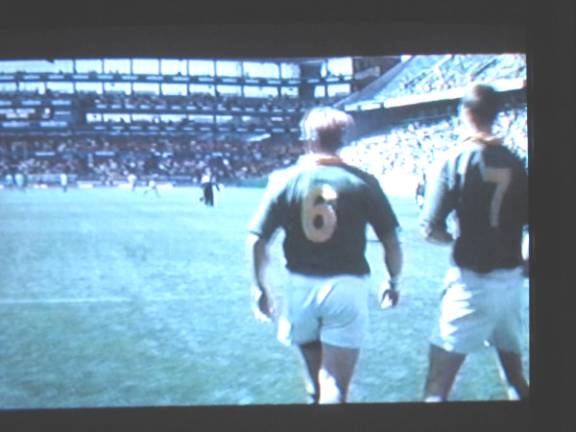
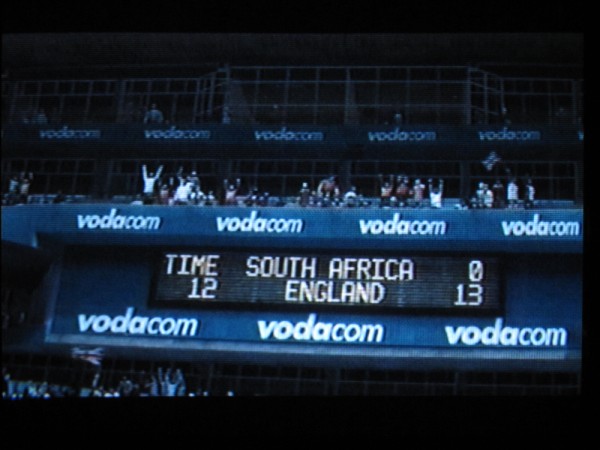
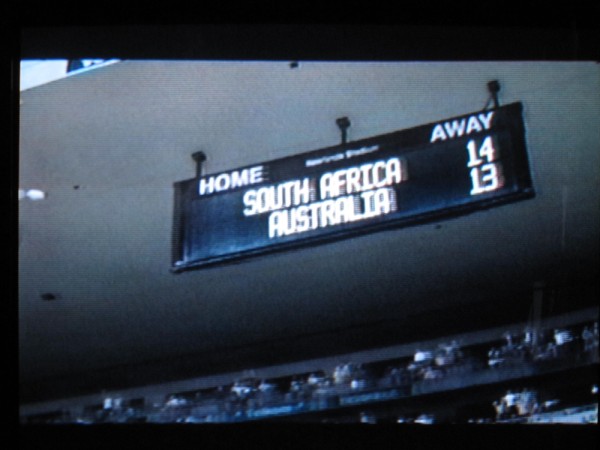
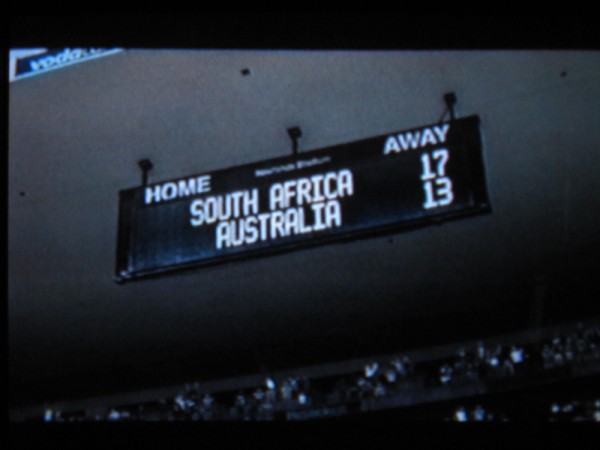
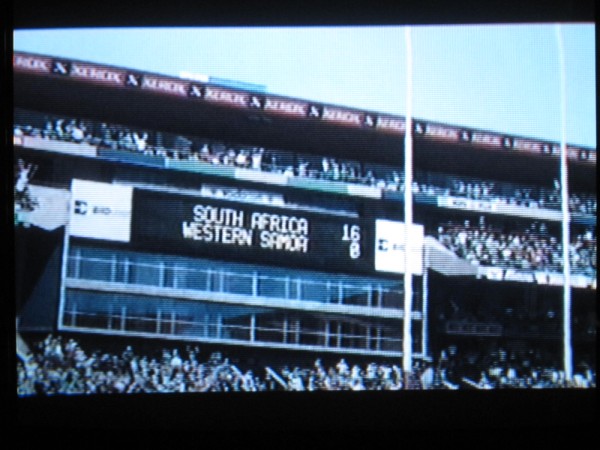
The issue of what coalition leaders have agreed to do – and stated so many times on the diplomatic record* – and not yet followed through on haunts some partners:
- White House, CBS and NBC Tag-Team to Send the Message that Coalition “Rage is Still Building”, It’s Partners Won’t Renege on Objective Promises and Coercive Diplomacy Isn’t Just Talk; and Auditor General of Canada Declines to Investigate Canada’s Non-Transparent Constituent of Governance
- Imprisoning the Malfeasant: “A Promise Made, A Promise Kept”; and Rendition is Not Just a Threat – It’s a Reality; and The Triple “T” of Canadian Governance – Theft, Torment and Torture – is in the Process of Coming to an End
- President Obama: “I Promise”, Confirming Again the Custodian Chief Executive’s White House Invitation and Dozens More Communiqués; and Chinada Principals Respond With a Triggering Event Style Belligerence
- President Obama: Stresses Each Coalition Representation Related to Stated Objectives is “Not an Empty Promise”; and NBC News Executives: Look at This -> Attaining Justice Requires Covert Regime Change Employing Military Force
- The Coalition Again Assures the Custodian Chief Executive All Representations, Assurances and Promises Will be Kept
- French President Sarkozy: Acknowledges Custodian Chief Executive Election, Assures the Coalition Will Follow Through on All Offers and Promises and Dozens More Communiqués
As Mandela’s in the stands watching a game he’s scripted to state “Why don’t we do a little work while we watch? We have a lot of promises to keep”. His secretary’s choreographed to effect a Colbert Maneuver when responding with “So we do” and an extra behind them a Prince Harry Maneuver to make sure the point is observed to be made.

The hatred of South Africa’s indigenous population for its oppressors runs so deep that as Apartheid is being dismantled the rugby association votes to get rid of one of its major symbols. Mandela shows up at the meeting where this occurs to make the case for why doing so is not in the country’s best interests. During the scene Eastwood et al. generate the message that the coalition will be victorious over Chinada as its predecessor was with respect to the Soviet Union:
[In prison] I had to know my enemy [audience: Execution M.] before I could prevail; and we did prevail, did we not? All of us have [audience: Z-J M.], we prevailed.
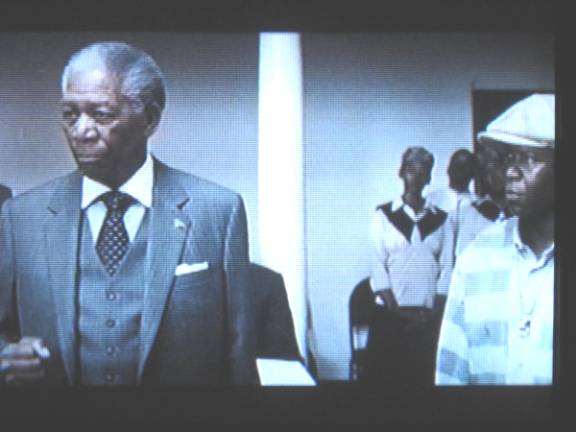
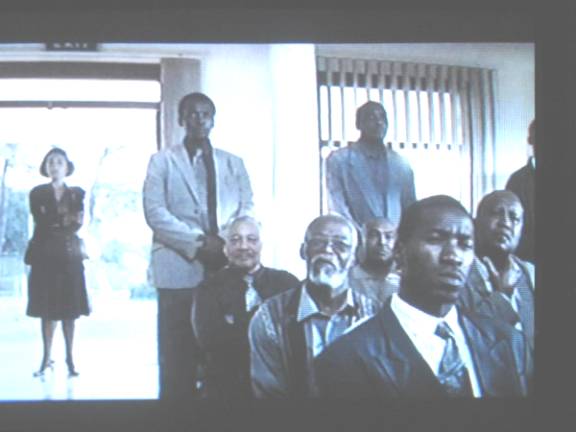
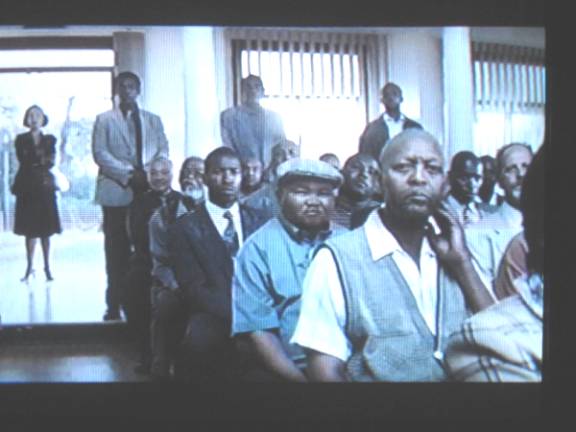
In the car going back to the office he and his secretary exchange views. Geo-politically relevant was her line “12 votes”, a coalition identifier; and as she’s doing so brushes his lapel, a Harriet Maneuver, a compensation ratifying – Custodian Chief identifying five times, which serves to confirm how the issue of quantum continues to be a promise that has not been forgotten.

A discussion with an aid in his office underscores how critical it is for the coalition to prevail over the 21st century’s first totalitarian threat. To “[I]t is very important that we beat Australia” Mandela executes an Erin Maneuver while his assistant a British Parliamentary Maneuver (to draw attention to Canada’s Commonwealth status); and that’s followed by the former effecting a protracted Greenspan Maneuver to underscore the need to make it Democracy 2, Imperialistic Totalitarianism 0.

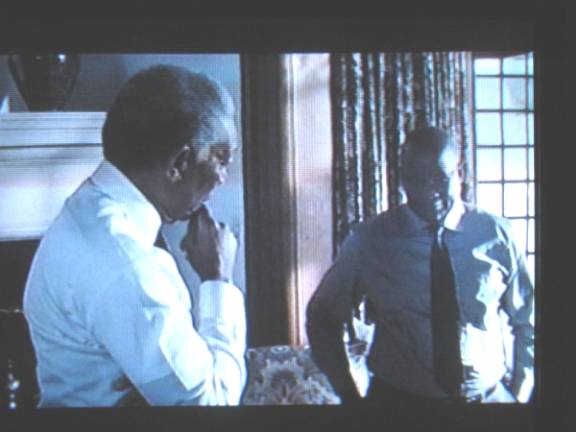
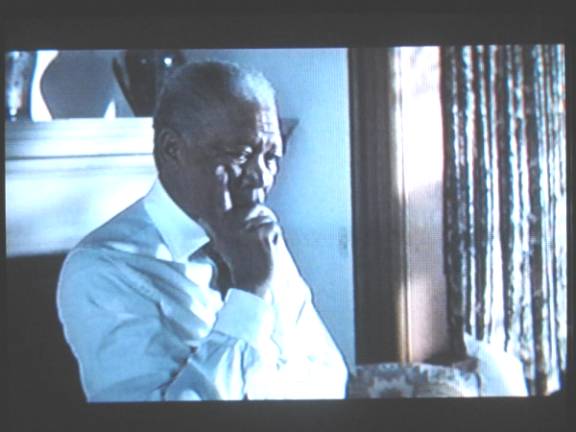
The Custodian Chief’s international persona, his supra-celebrity status, and his coalition-elevated position within Canadian society is highlighted. During a scene where a sports commentator is filming a segment on the South African rugby team’s chances to win the World Cup, Eastwood et al. draw on the lexicon’s lab monkey theme: “[The opposition is] possibly one of the greatest [bananas] international [teams] ever … as dominant as this correspondent has ever seen”.
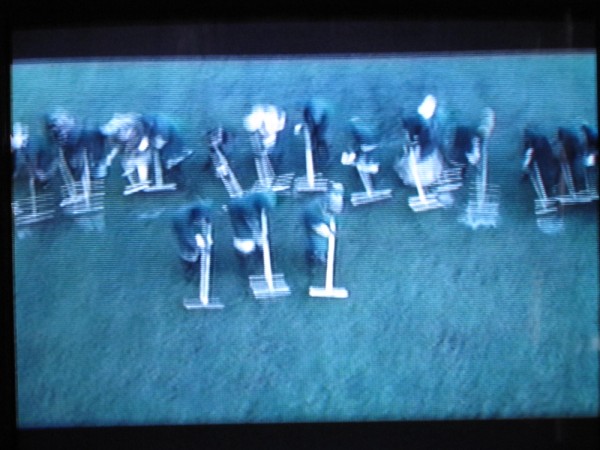
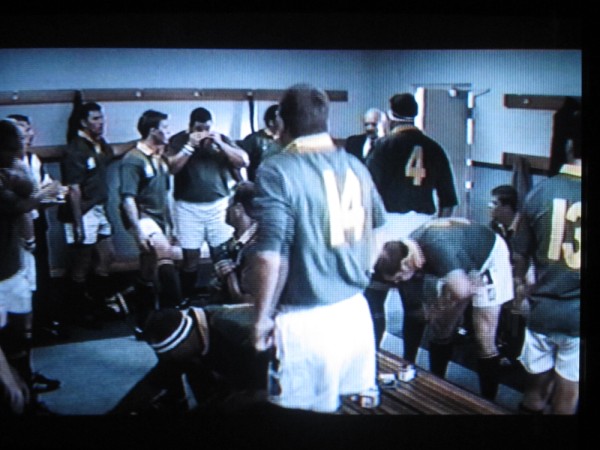
Producers’ clever composition skills are observed during a scene in which rain has soaked the field. They choreograph a line of field attendants to push the accumulated water off the pitch, arranging for a coalition identifying three of them to be in the front. And immediately following is a locker room scene in which they juxtapose a Taylor Identifier with a Custodian Chief identifier to draw attention to their high level importance within the coalition.
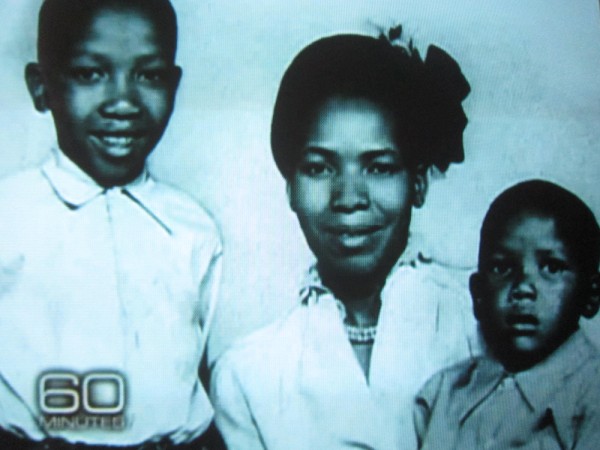
Most all geo-politicized films aren't viewed and diplomacy not documented and archived until they come out on DVD or television. Thus, it wouldn’t be until the first weekend of October 2010 that ‘Invictus’ was watched. And most coincidentally the following day, Sunday, ’60 Minutes’ broadcast a segment on the former President of South Africa. It too is a testament to how much the coalition considers the Custodian Chief the next leader of Canada.
Beyond what was red flagged by the lexicon as geo-relevant (see infra), there are some parallels worth noting. For example, Bob Simon refers to the fact that while in jail Mandela “organize[d] the prisoners into a government in waiting”; that he “never doubted that the racist regime would be overthrown”; and “back then, he started preparing”. The same goes for the Custodian Chief. One of the reasons for the edification and accountability initiatives beyond identifying those who would face justice for violations of domestic and international law was to find out who was on the malfeasant side of the institutional ‘Chinese Wall’ and who wasn’t and therefore recruitable and trustworthy enough to help form the transition government from militarized totalitarianism to democracy.
Another portion of the segment dealt with the subject of how the malfeasant are to be treated when regime change was effected:
[Mandela] got a visit from a general who was intent on putting Mandela in his place. And he says to Mandela, 'Mandela? You better remember you are a prisoner.' And in a very polite way he says to him, 'General, you and I may be generals on the opposite side of this war. At some point even if it is to accept the surrender from the other we'll have to meet. And how we treat each other now will determine how we interact at that moment’.
The Custodian Chief has made it unambiguously clear over and over that the prosecution and sentencing philosophy will be “no mitigation, no mercy, no exceptions”. And in response he got back” “it’s all or nothing”.
Another reference that’s relevant is Mandela’s competence. The Mandela Foundation archivist pointed out that when the authorities tried to compromise him “in ways that would have been irredeemable”, “he didn't make one mistake”. Similarly, the Custodian Chief was faced with innumerable circumstances that would have jeopardized the reform and accountability agenda. They involved how he responded to on-going hypno-torture, death threats and other activities that sought to provoke him. He always remained cool, calm and collected and reacted in ways that prevented another psych ward committal. And when it came to his coalition partners, his clients, he always treated them equally despite disparities involving their respective stations in life, never deviated from holding them in high esteem and always strove for competence, trustworthiness and surpassing expectations. He too never erred during the long and arduous road to regime change.
Mandela’s archivist when asked "How do you explain that incredible confidence?" replies with "I think from very early on he had a very strong sense of destiny” and “one day he [8:00: Bl.M.] would be called President Mandela”.
Different about South Africa and Canada is how Mandela treated the old guard. He hired from the rank and file and “wanted his old oppressors to know they'd be okay in the new South Africa”. Due to the nature of the Chinada threat that solution is not applicable. In possession of the 21st century’s Pandora’s Box, stealth cognition technologies, not incarcerating them en masse will lead to them picking up in another country where they were forced to leave off – a jurisdiction in which the elite there wants the latest technologies and techniques to oppress, torture, torment and threaten its people and help them help China pursue its global ambitions.
The lexicon’s use began with the segment’s runtime: 12:38 – a double coalition identifier and China identifier.
And eight seconds into the intro Bob employs a Taylor Identifier to compare Mandela’s international persona with the Custodian Chief’s. Moments later he draws attention to how some coalition partners want to disclose to the world that which threatens its peace, security and prosperity:
Nelson Mandela may well be the most admired human being alive. It's difficult to imagine who could [0:08: T.M.] compete with him for the title. He went from being prisoner to president and, in the process, became an icon. But he is such a private man that we know very little about what he felt and thought throughout the 92 years of his life. [0:22: 60 MM] That is, until now.
A minute later when the democracy icon is observed in the company of and engaging school children the lexicon is employed to generate the communiqué that the malfeasant are going to be “captured” – in other words arrested, prosecuted, convicted and sentenced:
That's the Mandela we've seen so little of - the Mandela who is [1:25: Branson M.] captured in "Conversations with Myself." The book project began with an extraordinary mandate from him: take my personal archives and do what you want with them.

The archivist describes how the South Africans tried to compromise Mandela’s integrity; and his words were turned into coercive diplomacy:
The regime […] tried to undermine Mandela in the most insidious way: he was moved to a private house in a prison on the mainland, equipped with a chef and a swimming pool. Officials came to see him, brought along a case of wine, and tempted him to sell out. "This was the key moment for me in Nelson Mandela's life. This was when he was most at risk, [7:07: Bl.M.] because he starts negotiating from prison on his own. He's incredibly vulnerable," Verne Harris explained.

"I think from very early on he had a very strong sense of destiny. And there was almost a sense that he knew he needed to go to prison before coming out to do the work that awaited him," he replied.
"He knew before he was captured, that one day he [8:00:; Bl.M.] would be called President Mandela?" Simon asked.
"I think so," Harris said.

When interviewing one of his predecessor’s staff, Bob Simon used another Blair Maneuver to articulate how coalition partners, both members and the invited, were “shocked” at what they learned about the Custodian Chief’s predicament; especially the fact it persisted over a twenty year period:
"And he stopped me and he started speaking in Afrikaans with me," La Grange remembered. "Which is my home language. And I didn't understand a word he was saying because I was so shocked. [9:13: Bl.M.] There was a feeling of guilt immediately overtaking my emotions that I felt responsible for taking away so many years of his life." [8:24: Bl.M.]

Producers combined a description of what such an international persona as Mandela and the Custodian Chief have delivers with a clip of Morgan Freeman visiting the former. He chose Canadian prison certainty to appear in.
It wasn't long before La Grange became his most trusted assistant. For the last 16 years, every pop star, politician, president or pope who wanted to see the great man knew enough to [10:02: Can pc] cozy up to Zelda La Grange.

The retired South African president didn’t have an admirable personal life before incarceration. During that portion of the segment on this period of time a Taylor Identifier is added to underscore the immoral nature of Canadian governance and a coalition identifier to once again articulate how the community of democracy, rule of law and human rights advocates is going to effect a “divorce” of the geo-marriage between China and Canada that was consummated in the late 1970s.
And Mandela was the first to admit […] he'd "led a thoroughly immoral life." [10:58: C.I.] His first wife divorced him, at least in part because of his alleged infidelities.